
In 2020, I co-founded Shed Red—a non-profit organization that seeks to address period poverty in Canada, destigmatize menstruation, and inspire agents of change. Over the past year, my team has launched a Red Talks initiative: comprehensive, 45 minute community-based lectures regarding period poverty delivered to high school students in Ontario and British Columbia. To date, we’ve educated 150+ students (both males and females), dispelling the stigma surrounding menstruation and encouraging allyship.
Despite these efforts, in my conversations with students, I discovered that many were still reluctant to share their experiences related to periods in a classroom setting, and felt embarrassed to engage in open dialogue about menstrual health.
Through this card game, It’s About Bloody Time, my mission is to kickstart meaningful conversations about menstruation and educate my generation about period poverty through a Canadian lens.
Check out the full PRD or read the quick snippets below!
To address the problem at hand, I first understood the pain points our users face. After interacting with numerous high school students from grades 9 to 11, we discovered that the initial conversation starter served as the key roadblock. In other words, if one member of the group mustered the courage to speak up and share their experiences, others followed suit. This insight allowed us to focus on solving the following question:
How can we minimize the awkwardness involved in initiating menstruation-related conversations in a classroom setting?
In this discovery stage, a secondary issue was brought to our attention by educators. They lacked engaging and interactive resources to teach students about menstruation and issues related to it. As such, the scope of our project evolved into the following:
I segmented out user base into two distinct groups:
When approaching this problem, we analyzed why users are uncomfortable publicly speaking about periods and found that it was due to an underlying feeling of awkwardness. Thus, a potential approach could be providing a structured framework to engage in conversations surrounding this topic. Through prompting questions, we can nudge users to think critically about their experiences.
Value Proposition
By offering users a structured framework when discussing a taboo topic, they will be able to confidently share their experiences and further their knowledge.
Goals
Non-Goals
This game is not intended to do the following:
Iteration 1
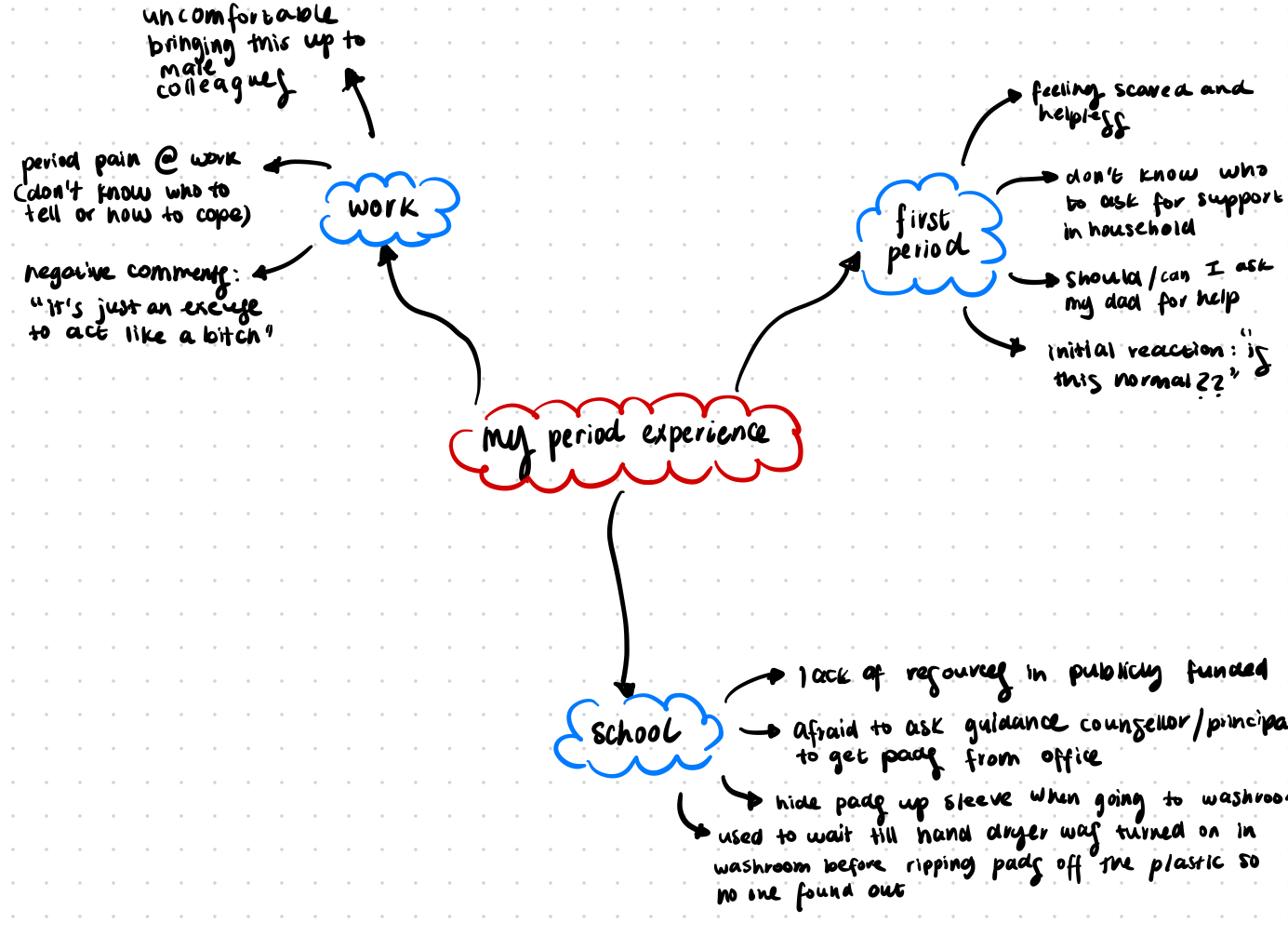
We began by brainstorming an individual's experiences related to menstruation in both their public and private spheres, which ultimately helped us in creating the prompting questions. Here’s a small excerpt from our brainstorming session:
Our initial wireframes were made with pen and paper, as shown below:

We then built the high fidelity wireframes using Figma, which can be found here. This was our first time using Figma to build something from scratch, and we learned a lot about the tool in the process.

Iteration 2
After creating the high fidelity mockups, we conducted user testing with students and educators to obtain valuable feedback:
Findings from User Sessions with Students
Findings from User Sessions with Educators
Each deck consists of 52 carefully crafted questions to foster a deeper understanding about menstrual health and period poverty in Canada. There are three distinct levels: awareness, reflection, and allyship, in addition to fact-based cards which function as “wildcards”.
Note: Users will be given the opportunity to discuss with their peers for approximately 20 minutes per level. The game is flexible in that they can choose to move to the next level whenever they feel is appropriate. Non-menstruators can actively listen to their peers in levels 1 and 2, and will be able to contribute in level 3.
Level 1 (Awareness): This level encourages users to share their personal experiences as it relates to menstruation.
Level 2 (Reflection): This level spotlights how social stigmas have impacted the user’s experience as a menstruator.
Level 3 (Allyship): This level is split into two sections: For Menstruators and For Allies
Fact-Based Cards (Wild Cards): Fact-based cards provide an opportunity for individuals to learn an interesting statistic related to period poverty, access to menstrual hygiene products, social stigmas, and more.
Steps

With the support of educational and other non-profit partners, we've been able to distribute ~100 decks till date and are currently working on developing a French-language edition. Here's a picture of the final product:

shoot an email to anja.somar@gmail.com